
THE CHALLENGE
While an East Coast chemical plant that manufactures phenol, acetone, and alpha-methyl styrene from cumene already had a carbon recovery system in place, they needed a separate system to control low concentration residual stream from the carbon recovery process. The phenol is consumed internally as an intermediate chemical during the process, and the acetone and alpha-methyl styrene are sold to another plant to make carpet fibers.
After a thorough vendor evaluation process, the plant contracted Anguil Environmental Systems to solve their emission problem. Plant engineers were concerned that an oxidation system might have an adverse effect on the precise pressure and volume control required in their production process. Anguil’s experience, and success, with chemical process applications provided the plant personnel with the confidence that catalytic oxidation was a viable solution.
THE SOLUTION
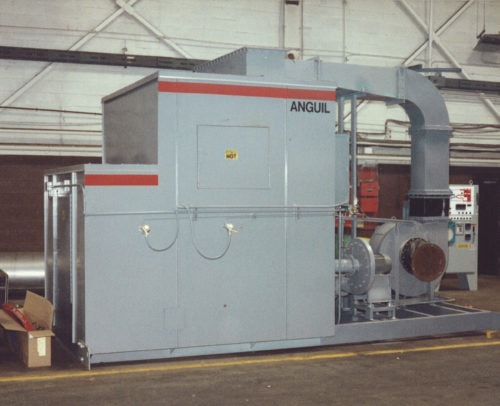
An Anguil Model 400 forced draft catalytic oxidizer, rated for 65,000 SCFM (102,512 Nm3/Hr) was selected to process the flow from 25 sources of production emissions. Anguil’s engineering staff worked closely with the customer throughout the design and manufacturing processes to ensure the system met their requirements. The system was sized to provide 99% destruction removal efficiency (DRE) and 70% thermal energy recovery (TER). The reactor section contains a catalyst bed to oxidize the incoming airflow. The catalyst converts volatile organic compounds (VOCs) into carbon dioxide (CO2), water vapor, and thermal energy.
THE RESULT
To address the concern of the precise pressure and volume control required for the customer’s production process, Anguil manufactured a four-module fully-welded shell and tube heat exchanger. By using a greater plate thickness, as well as fabricating “ribs” and “dimples” on the plates, a pressure differential of 87.5 of water column (w.c.) was sustained. The fully-welded design also eliminated the need for replaceable gaskets, while withstanding higher pressures and temperatures.
Since the plant’s process operates 24 hours a day, seven days a week, a programmable logic control (PLC) was integrated into the customer’s control system. This industrial-grade computer was designed to monitor and reduce redundancies of the most critical manufacturing processes in order to prevent any unexpected downtime. The new oxidation unit runs continuously, with 100% functionality and 99% destruction efficiency to accommodate the aggressive chemical production process without interruption.