


THE CHALLENGE
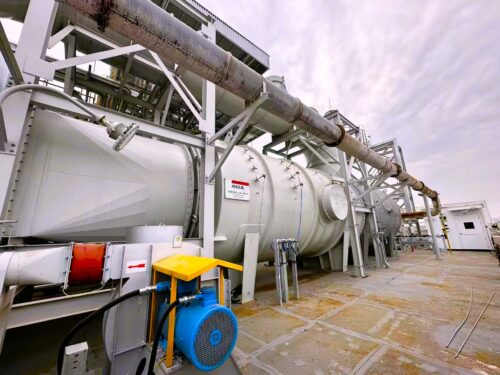
Polyamide (PI) film is a high-performance material renowned for its exceptional insulation properties, making it indispensable in electronics, aerospace, and automotive industries. A Chinese film producer recently planned to build a new PI film production line to meet growing market demand. However, the production process—specifically the imidization process adopted for the new line—posed a significant environmental challenge: it would generate large volumes of waste gas during film formation and spreading stages.
The waste gas, with a flow rate of 31,000 SCFM (50,000 Nm³/h), contained key pollutants including N,N-Dimethylformamide (DMF), isoquinoline, acetic anhydride, and acetic acid. A critical concern was NOₓ emissions: since DMF and isoquinoline are nitrogen-containing compounds, their oxidation during treatment could produce NOₓ. To comply with national and local environmental standards, the producer required a waste gas treatment system that not only removes Volatile Organic Compounds (VOCs) but also strictly controls NOₓ levels, reducing the facility’s carbon footprint.
THE SOLUTION
After a comprehensive evaluation of technical feasibility, energy efficiency, and compliance potential, the producer partnered with Anguil in Asia to design and construct a tailored waste gas treatment system. The core design integrated four key functions: VOCs abatement, waste heat recovery, denitrification, and real-time monitoring. This ensured the system met both emission standards and the producer’s operational cost goals.
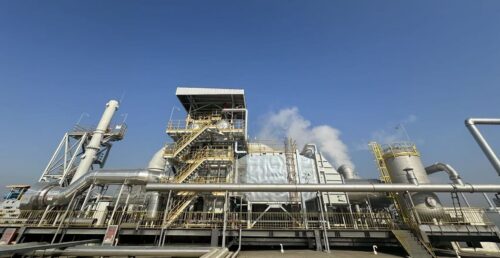
Full Process Flow Overview
The waste gas treatment process follows a sequential, high-efficiency design to maximize pollutant removal and energy reuse:
Waste Gas Inlet: Raw waste gas is first directed to an LEL (Lower Explosive Limit) detector to monitor combustible gas concentration, ensuring it stays below safe thresholds to prevent combustion risks.
Thermal Oxidizer (TO): The pre-screened gas enters the TO, where VOCs (e.g., DMF and acetic anhydride) are oxidized at high temperatures into CO₂ and H₂O, along with a small amount of NOₓ.
Heat Exchangers:
Heat Exchanger #1: Captures heat from the TO’s high-temperature exhaust to preheat combustion air to over 392°F (200°C), reducing fuel consumption.
Heat Exchanger #2: Further recovers waste heat to preheat incoming waste gas from approximately 302°F (150°C) to over 932°F (500°C), minimizing the TO’s energy demand.
Boiler: The remaining high-temperature exhaust, after heat exchange, is routed to a boiler where it generates saturated steam for the PI film production line’s heating processes.
SCR System: After steam generation, the exhaust passes through a Selective Catalytic Reduction (SCR) system equipped with high-performance catalysts that convert NOₓ into N₂ and H₂O, ensuring regulatory compliance.
Economizer: The cooled exhaust then flows through an economizer to preheat boiler feedwater, maximizing final heat recovery.
Induced Draft Fan & Stack: Downstream is an induced draft fan pushes the treated exhaust through the stack, which is equipped with an explosion-proof Continuous Emissions Monitoring System (CEMS) for real-time emissions monitoring.
Key Equipment Advantages
Each component of the system is optimized for efficiency, compliance, and reliability:
Thermal Oxidizer (TO): As the core of VOCs abatement, it features two critical designs:
- Choke Ring Structure: Installed inside the TO, this structure enhances gas turbulence, extends the gas residence time, and ensures uniform mixing—boosting VOCs removal efficiency to over 99.9%.
- Low-Nitrogen Burner: Reduces the formation of thermal NOₓ (NOₓ generated from high-temperature air oxidation) by controlling combustion temperature and oxygen distribution, addressing NOₓ risks at the source.
Waste Heat Recovery Boiler: Converts waste heat from the TO’s exhaust into saturated steam of 6.5 tons/hour, 1.0MPaG which is reused in the PI film production line. This not only replaces the need for a separate steam boiler but also cuts the producer’s annual energy costs significantly.
SCR System: Uses high-performance dedicated catalysts to remove NOₓ. It is paired with an online NOₓ analyzer that monitors exhaust NOₓ concentration in real time and automatically adjusts the reducing agent (e.g., ammonia) injection rate—ensuring stable NOₓ control even with fluctuating waste gas composition.
LEL Detector: Installed at the waste gas inlet, it provides 24/7 monitoring of combustible gas levels. If concentrations approach the explosive limit, the system triggers an alarm and adjusts gas flow, preventing safety hazards.
Explosion-Proof CEMS: Mounted on the stack, the Continuous Emission Monitoring System (CEMS) tracks key pollutants (NOₓ, VOCs, Non-Methane Hydrocarbons/NMHCs) and transmits real-time data to local environmental monitoring authorities. This ensures full transparency and compliance with regulatory reporting requirements.
THE RESULTS
The waste gas treatment system was completed and put into operation. After a one-month trial run and official testing, the system achieved outstanding performance:
- VOCs Removal: VOCs removal efficiency reached 99.9%, far exceeding the minimum requirement of 95%.
- NMHC Compliance: The treated exhaust’s NMHC concentration was measured at 10 mg/Nm³, well below the local standard limit of 30 mg/Nm³.
- NOₓ Control: NOₓ concentration in the stack exhaust was 40 mg/Nm³, significantly lower than the national standard limit of 100 mg/Nm³.
Beyond compliance, the system delivered substantial economic benefits. The boiler’s saturated steam supply stably, reduce the producer’s natural gas consumption and cutting annual operating costs. The heat exchangers’ energy recovery reduced the TO’s fuel consumption, further lowering energy expenses.
By combining thermal oxidation, waste heat recovery, and SCR denitrification, Anguil Asia’s solution not only helped the producer meet strict emission standards but also turned waste gas into a valuable energy resource. As environmental regulations continue to tighten, such “treatment + energy reuse” solutions will become increasingly critical for balancing industrial development and ecological protection.