

Anguil has decades of experience designing and supplying electric-powered, hydrogen-fueled, and alternative fuel oxidizer systems for industrial VOC and HAP compliance.
While the electrically heated Catalytic Recuperative Oxidizer (CATOX) has been widely applied for years, the integration of electric heating elements and hydrogen-fueled burners into higher-volume thermal oxidizer platforms, including the Regenerative Thermal Oxidizer (RTO), Direct Fired Thermal Oxidizer (DFTO), and Thermal Recuperative Oxidizer, has been slower to take hold across the industry.
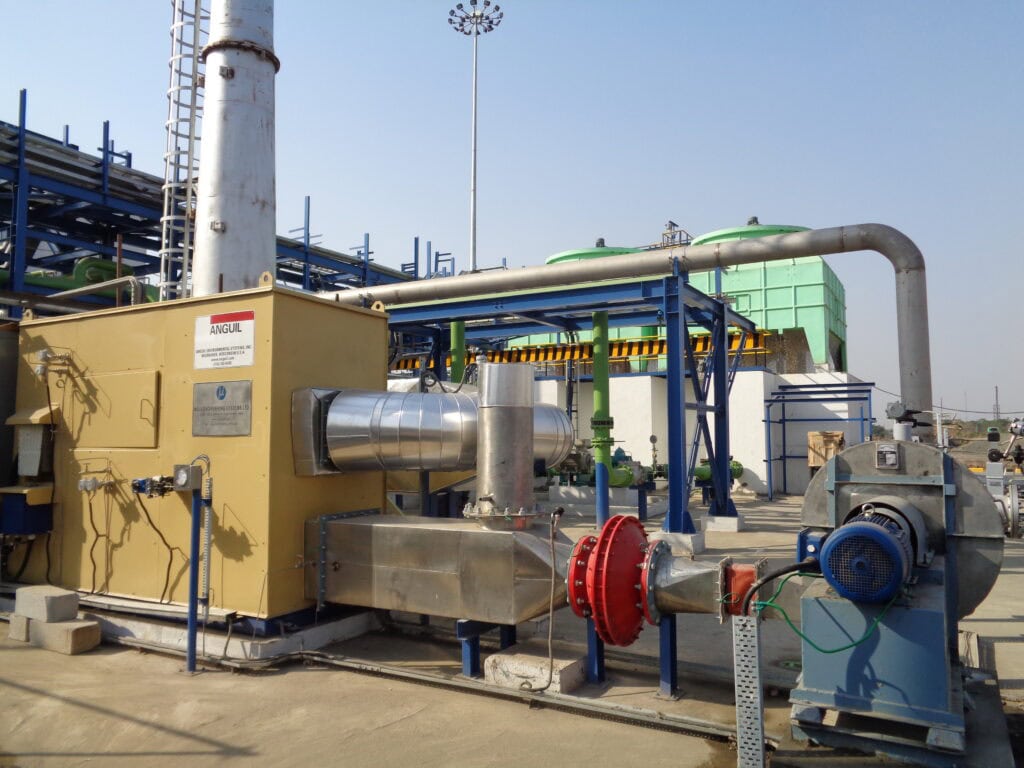
Anguil is at the forefront of low-carbon (LoCarb) oxidation, with production-proven electric RTO (eRTO) designs, hydrogen-fueled burner systems, and LPG and renewable natural gas (RNG) configurations available for both thermal and catalytic oxidizers.
Why Facility Managers Choose Anguil’s Low-Carbon & Electric-Powered Oxidizers
Anguil’s flameless electric RTO and LoCarb oxidizer systems offer several advantages over conventional gas-fired burner systems, including:
- Uniform heat distribution
- Faster installation with reduced wiring and no burner tuning
- Eliminate fossil fuels for a smaller emissions footprint
- Scalability, allowing for extra heating capacity if needed
- No fuel train requirements
For facilities with access to green hydrogen or blue hydrogen infrastructure, Anguil also offers specialty hydrogen-fueled burners that eliminate SOx and CO₂ emissions from the heating source, with significantly reduced NOx compared to natural gas combustion.
For sites without natural gas access, Anguil designs oxidizer systems for liquefied petroleum gas (LPG) and renewable natural gas (RNG), providing compliance-grade VOC destruction without fossil fuel dependencies.
-
Product Overview
Benefits of Anguil’s LoCarb Oxidizers
When compared to traditional fossil fuel combustion systems, these industry leading technologies offer:
- Lower Carbon Footprint
- Faster Installation
- Enhanced Flexibility During Low-Flow Conditions
- Reduced Maintenance & High Reliability
- Comparable Capital Costs

-
LoCarb-eRTO Features
Features of Anguil’s LoCarb-eRTO
When compared to traditional natural gas fired combustion systems, this industry leading technology offers:
- Reduces greenhouse gases produced from fossil fuel heating source (NOx, CO2, SOx)
- High thermal efficiency to reduce heater sizing
- High VOC destruction efficiency
- No products of incomplete fossil fuel combustion
- Eliminates need for gas connections, fuel trains, burners and combustion air fan
- Same footprint as a gas fired RTO
- Dual heating source functionality is an option for redundancy

-
Ideal Applications
Ideal Applications
- Facilities following ESG (Environmental, Social, Governance) standards
- Facilities lacking fossil fuel access

How Does a LoCarb Alternative Fuel Oxidizer Work?
The particular n and m subscripts of the equation are used to define the number of carbon atoms and hydrogen atoms. The number of oxygen atoms convert to n molecules of carbon dioxide and m molecules of water vapor and heat.
This equation highlights the oxidation reaction that is occurring in a gas fired burner that is historically used in thermal and catalytic oxidizers. The oxidation equation for burning natural gas (methane) is shown in the below equation:
CH4 + 2 O2 → CO2 + 2 H2O (+ Heat + NOx)
(CO2 and NOx removed when using electric heat source)
In addition to the formation of CO2, NOx is also produced due to the high temperature of the burner flame. Replacing a gas fired burner with an electric heater eliminates the CO2 and NOx that is generated from the heating source. CO2 will still be produced from the oxidation of the VOCs themselves in either a gas or electrically heated RTO.
How Does a LoCarb-eRTO Work?
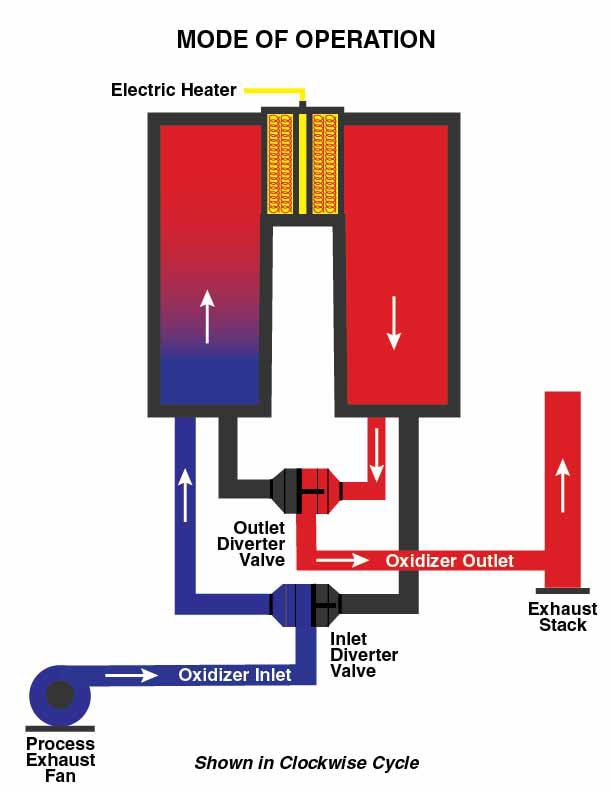
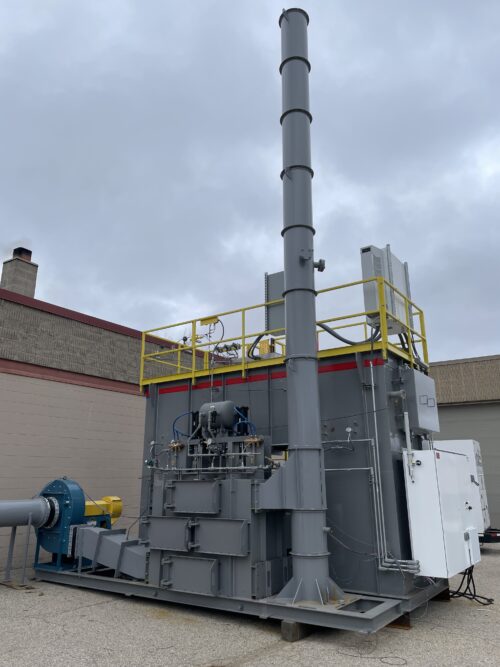
Once oxidized in the combustion chamber, the hot purified gas releases thermal energy as it passes through the media bed in the outlet flow direction. The outlet bed is heated, and the gas is cooled so that the outlet gas temperature is only slightly higher than the process inlet temperature. Poppet valves alternate the airflow direction into the media beds to maximize energy recovery within the oxidizer. The high energy recovery within these oxidizers reduces the auxiliary energy input requirement from the electric heater and saves operating cost. The Anguil LoCarb oxidizer achieves high destruction efficiency and self-sustaining operation with no auxiliary energy input to the electric heater at concentrations as low as 3-4% LEL (Lower Explosive Limit).
LoCarb Hydrogen-Fueled Oxidizers: Green Hydrogen, Blue Hydrogen & Dual-Fuel Burner Options
For facilities with access to green hydrogen or blue hydrogen, Anguil offers specialty hydrogen-fueled burners designed for RTO, DFTO, and Thermal Recuperative Oxidizer platforms. Hydrogen combustion eliminates CO₂ and SOx emissions from the heating source.
NOx output is significantly lower than natural gas combustion, though not zero, since hydrogen’s high adiabatic flame temperature still drives some thermal NOx formation. Anguil’s burner designs account for this through optimized geometry and combustion controls.
Many commercial burner manufacturers have engineered their products to operate on either natural gas or hydrogen with minimal modification, allowing existing gas-fired oxidizer owners to evaluate a hydrogen fuel conversion without full system replacement. Anguil can assess the feasibility and provide the same high thermal energy recovery and VOC destruction efficiencies regardless of fuel choice.
Greenhouse Gas Reduction in an Electric RTO
The benefits of an electrically heated RTO is apparent when looking at the CO2 and NOx production estimates against a traditional natural gas fired RTO. Anguil has compared our standard Model 50 Two Bed gas fired RTO against our Model 50 LoCarb-eRTO with the same process conditions (5,000 SCFM process flow at 70°F and 8,760 operating hours per year). The CO2 generated in tons per year from the natural gas fired burner has been charted against the VOC loading in the process (Chart #1).
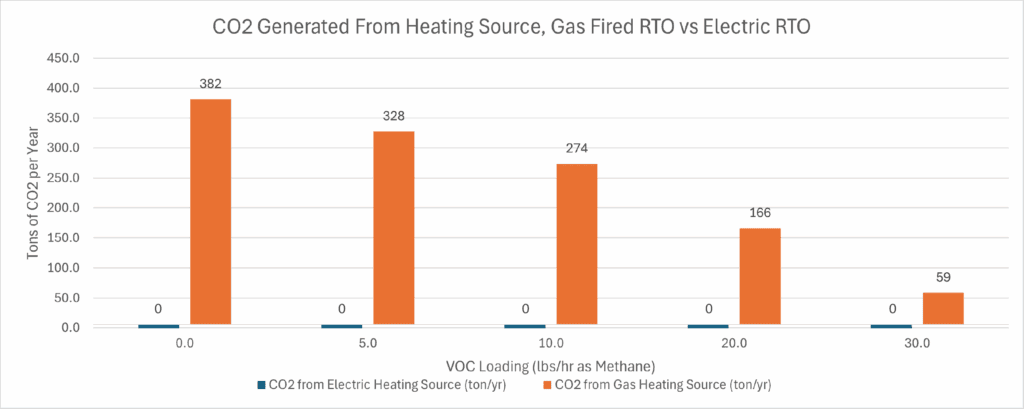 Chart #1 (5,000 SCFM, 70°F, 8,760 hours per year)
This only considers the CO2 generated from the burner itself, not the CO2 produced from the oxidation of the VOCs. Using an electric heater in the RTO eliminates the CO2 produced from the heating source.
Similarly, the NOx generated in tons per year from the natural gas fired burner has been charted against the VOC loading in the process (Chart #2). This assumes that there are no nitrogen bearing VOCs present such that the only NOx produced is from the burner flame. The electrically heated RTO does not produce any NOx in comparison.
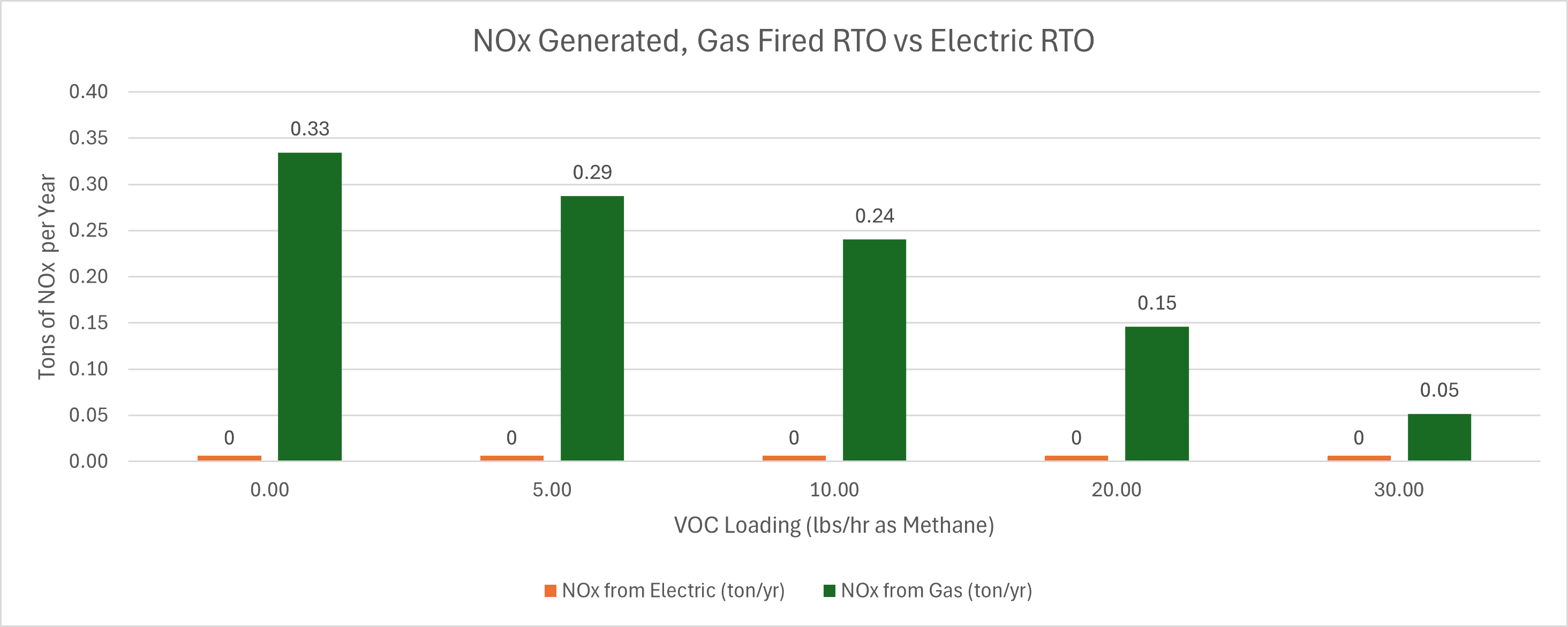 Chart #2 (5,000 SCFM, 70°F process, 8,760 hours per year)
Will a LoCarb oxidizer technology work for your application?
Let us help your company achieve its’ climate objectives with a technology analysis. Anguil would be pleased to provide a preliminary technological analysis between a gas fired oxidizer versus a LoCarb oxidizer. Included in that analysis will be an estimate for both capital and operating costs, as well as utility use numbers.
FAQs: Electric RTOs & Alternative Fuel Oxidizers
Q: What is an electric RTO (eRTO)?
A: An electric regenerative thermal oxidizer (eRTO) is a flameless version of a standard RTO in which electric resistance heating elements replace the gas-fired burner. The ceramic media heat recovery beds, poppet valve switching, and combustion chamber all operate identically to a conventional RTO. The only difference is the heat source: instead of burning natural gas to maintain operating temperature, electric elements supply the auxiliary heat needed. This eliminates all CO₂ and NOx emissions generated by the heating source.
Q: Does an electric RTO produce zero CO₂?
A: No — and this is an important technical distinction. An electric RTO eliminates CO₂ from the heating source (the burner), but the thermal oxidation of VOC compounds still produces CO₂ regardless of the heat source used. Both gas-fired and electric RTOs generate CO₂ from the oxidation of the hydrocarbons in the process stream. The electric RTO’s advantage is the removal of the additional CO₂ load from the combustion of natural gas to maintain operating temperature.
Q: Can an RTO run on hydrogen instead of natural gas?
A: Yes. Anguil offers specialty hydrogen-fueled burners designed for RTO, DFTO, and Thermal Recuperative Oxidizer platforms. Hydrogen combustion produces no CO₂ and no SOx. NOx output is significantly lower than natural gas but not zero — high-temperature hydrogen flames still produce some thermal NOx. Many burner manufacturers have designed dual-fuel capability into their products, allowing operation on natural gas, hydrogen, or a blend of both, which makes a hydrogen conversion feasible without full system replacement.
Q: What is a flameless regenerative thermal oxidizer?
A: A flameless regenerative thermal oxidizer is an RTO that uses electric heating elements rather than an open burner flame to maintain combustion chamber temperature. Because there is no flame, there are no products of incomplete combustion and no thermal NOx generated by the heat source. The VOC oxidation chemistry remains the same — the process stream is still heated to destruction temperatures (typically 1,400–1,500°F) and the ceramic media beds still recover and recycle up to 97% of the thermal energy.
Q: What is the difference between green hydrogen and blue hydrogen in oxidizer applications?
A: Green hydrogen is produced by electrolysis of water using renewable electricity (wind or solar), resulting in zero carbon emissions from production. Blue hydrogen is produced by conventional steam methane reforming but with carbon capture and storage (CCS) applied to the CO₂ byproduct — reducing production emissions by roughly 90%. In an oxidizer context, both fuels burn the same way and produce the same near-zero CO₂ and SOx emissions at the burner. The distinction is in the supply chain carbon intensity, which matters for Scope 1 and Scope 3 reporting.
Q: Can Anguil design an oxidizer for LPG or renewable natural gas (RNG)?
A: Yes. For facilities without natural gas infrastructure, Anguil designs oxidizer systems for liquefied petroleum gas (LPG). For facilities that want to reduce lifecycle carbon intensity without changing hardware, Anguil can configure systems for pipeline-quality renewable natural gas (RNG) — which is chemically identical to fossil natural gas but produced from biological sources. RNG reduces the net carbon footprint of combustion while using existing burner and fuel train hardware.
Q: Does switching to an electric RTO require a different physical footprint?
A: No. Anguil’s LoCarb-eRTO is designed to have the same physical footprint as an equivalent gas-fired RTO. The elimination of the fuel train, combustion air fan, and burner assembly actually reduces the number of components — but the overall system dimensions and installation requirements are comparable. This makes electric RTO a viable replacement consideration during an RTO rebuild or upgrade cycle.