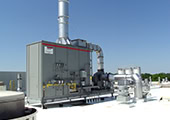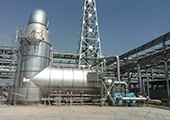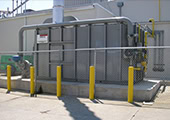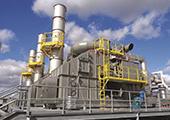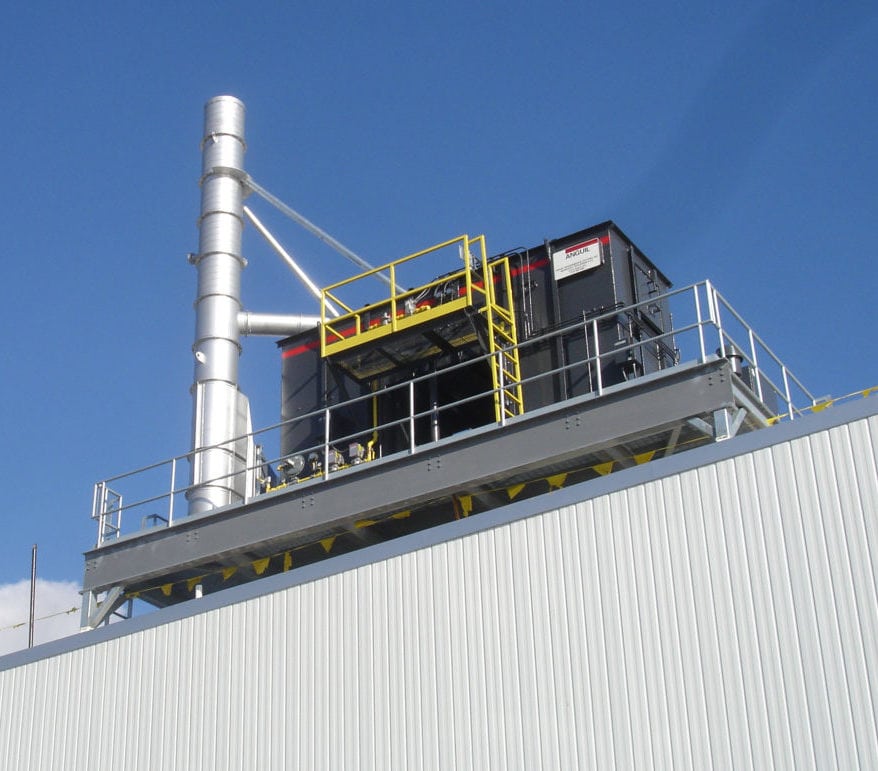


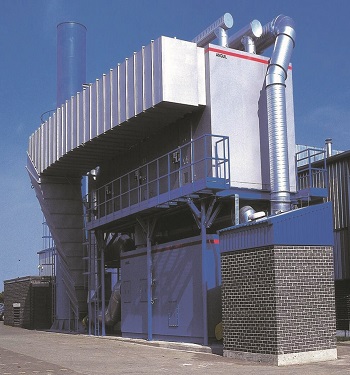
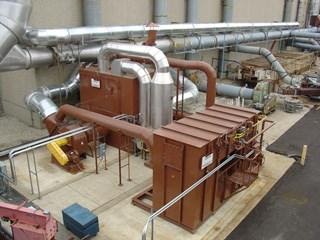
 The Anguil Emission Concentrator is an adsorption system designed to concentrate large volume, low concentration process exhaust into a much smaller, higher concentrated air stream.
The greatly reduced flow with higher Volatile Organic Compound (VOC) concentration is sent to a thermal or catalytic oxidizer for VOC destruction. The destruction device can then be much smaller in size, significantly reducing capital cost. The resultant higher VOC concentration controlled in the smaller abatement equipment minimizes auxiliary fuel consumption.
-
Product Overview
Benefits of Anguil’s Emission Concentrators
- Largest flow capacity in the industry at over 120,000 SCFM (192,600 Nm3/hr) in a single rotor
- Reduces abatement equipment size by 90-95% of the original volume, providing dramatic capital and operating cost energy savings
-
Air Flow Range & Efficiency
Air Flow Range
- 5,000-120,000 SCFM (8,025- 192,600 Nm3/hr) (Single Rotor)
Destruction & Removal Efficiency (DRE)
- 95-99% (Higher DRE can be reached with multiple rotors in series)
-
Ideal Applications
Ideal Applications
- Large Volume, Low Concentration
- Low relative humidity, 90% max RH
- Exhaust of 100°F (38°C) or less
ANGUIL EMISSION CONCENTRATOR FEATURES AND DESIGN OPTIONS
Features
- Completely shop assembled, pre-wired and test prior to shipment
- Zeolite adsorbent rotor minimizes risk of fires common to carbon systems with certain VOC/HAP emissions
- Low pressure drop, typically 3″-5″ W.C.
- Removal efficiencies of 95-99%
- Concentration ratios as high as 25:1
- Continuous adsorption of VOCs onto the rotor as opposed to a batch type adsorption vessels
- Concentrator rotor, desorption air heat and oxidizer integrated as a single system, simplifying installation and controls
- Over 120,000 SCFM (192,600 Nm3/hr) capacity with a single rotor system
- Robust Programmable Logic Controller (PLC) based controls with digital data recording, remote telemetry and various configuration options.
 Options
 Options
- Multiple rotors in series or parallel for even higher DRE or higher airflows
- Various zeolite substrate options to prevent polymerization
- High-efficiency filter plenums to protect the adsorbent from process particulate exhaust
- Numerous options for desorption air heat
- Fully-integrated concentrator – oxidizer systems, including common controls stream
How Do Emission Concentrators Work?
The high volume, low concentration airstream passes through a rotor concentrator where VOC emissions are stripped from the air and adsorbed onto the zeolite. The majority (approximately 90-95% of the total air volume) of this clean air is then exhausted to atmosphere. A small portion of the air stream (approximately 5-10% of the total air volume) is heated to an elevated temperature to be used as desorption air.
The concentrator rotor spins continuously at a very slow rate, transporting adsorbed pollutants into a desorption section. In the desorption section, the VOCs are desorbed or released from the adsorptive media with the low volume heated airstream. This low volume, high VOC-laden air is then processed by an oxidizer.
The concentrator with integrated oxidizer is often the most cost effective technology for processing high volume, low concentration streams. While the capital cost of a system is competitive with other technologies, the true savings is realized in reduced operating costs. When coupled with a concentrator, an oxidizer will operate with little to no natural gas consumption. At higher concentration values, it even has sufficient “free energy” to provide desorption energy for the concentrator.
Learn more about Emission Concentrators
Rotor and Seal Service Options
Over time, exposure to process contaminants, temperature fluctuations, and normal operating conditions can impact rotor performance and VOC removal efficiency. For example, air seals play a vital role in maintaining proper separation between process, desorption, and cooling zones within a concentrator rotor. Worn or damaged seals can lead to air leakage, reduced concentration ratios, increased energy consumption, and lower VOC removal efficiency. Our experienced technicians can assess seal and wheel condition, recommend replacement intervals, and complete installation with minimal disruption to operations.
From performance assessments and planned maintenance to full wheel replacement projects, we help minimize downtime and restore system efficiency.
Benefits
- Concentrator assessments and performance evaluations.
- Replacement rotors engineered for seamless system integration.
- Air seal inspection, replacement, and optimization services.
- Improved concentration efficiency and reduced energy consumption.
- Minimized downtime through planned maintenance programs.
- Factory-trained service and technical support throughout the project lifecycle.
Maximize the life and performance of your emission concentrator with Anguil rotor inspection, service, and replacement solutions.
Explore all Oxidizer Service and Maintenance options.