
THE CHALLENGE
 When a subsidiary of a global manufacturer of spray‑dried natural ingredients learned that its municipal wastewater discharge permit was about to be updated, leadership knew action was needed—and quickly. The new permit would impose tighter limits on pH, solids, organic loading, and discharge flow, creating both operational and financial risk for a facility already operating within tight physical and budgetary constraints.
The company had a strong track record as a responsible community partner and wanted to stay ahead of potential violations. To explore their options and avoid unexpected fines—or worse, a shutdown of wastewater discharge—they turned to Anguil for help.
Early conversations made one thing clear: pH compliance was non‑negotiable. The city made it clear that a single pH violation would trigger an immediate notice of violation, followed by steep fines and possible suspension of discharge privileges.
Unfortunately, this facility produced wastewater across one of the widest pH ranges Anguil typically encounters. Tomato- and vinegar‑based process streams come in around pH 3, while CIP operations introduced short bursts of wastewater with pH as high as 12–14. Any solution would need to reliably handle both extremes—automatically and without fail.
At the same time, the facility’s discharge flow told a story of its own. For most of the day, flows were below 100 GPM. But during CIP events, wastewater surged to more than 400 GPM in a short window. The updated permit, however, capped discharge to the city sewer at 100 GPM due to upstream capacity limitations.
As Anguil dug deeper, additional constraints surfaced:
- Wastewater contained elevated TSS, ammonia, and BOD
- The city required 100% secondary containment for 30,000 gallons of glacial acetic acid stored onsite
- The site had almost no available real estate for new construction
- Existing sumps commingled industrial wastewater with sanitary flows, which would need to be corrected
It was clear this wasn’t just a treatment challenge—it was a systems challenge.
THE SOLUTION
 Anguil worked closely with the client to quantify the real-world impact of the updated permit. Together, they evaluated the cost of violations and surcharges, the capital required for various treatment options, and the likelihood of corporate approval for major investments.
Technically, Anguil could design a system to reduce TSS, BOD, and ammonia using a dissolved air flotation (DAF) system and sludge dewatering. But when the numbers were put on the table, the return simply wasn’t there. Paying municipal surcharges for ammonia and residual BOD made more financial sense than installing and operating a full treatment train.
What did make sense was eliminating the risk of violations altogether and controlling discharge flow—while keeping capital costs in check.
Anguil initially developed a comprehensive treatment concept, including storage, pH adjustment, DAF, and a new treatment building. But geotechnical studies revealed that foundation work alone would drive costs well beyond what corporate leadership was willing to approve.
Rather than forcing a one-size-fits-all solution, Anguil recalibrated.
By listening closely to corporate feedback and site constraints, Anguil helped the client refocus on what mattered most:
- Guaranteed pH compliance
- Flow equalization to meet the 100 GPM discharge limit
- Sufficient storage to manage both process variability and secondary containment requirements
- A design that fit within the existing site and allowed future expansion if needed
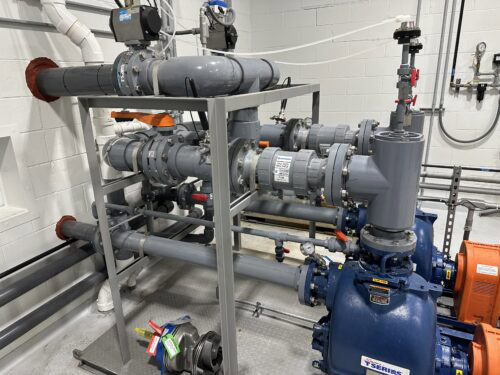
The final solution was a fully automated pH adjustment and flow control system, built around:
- A new dedicated process wastewater sump
- Approximately 80,000 gallon storage capacity in FRP tanks installed outdoors
- Continuous pH adjustment with mixing, and chemical dosing
- PLC-based automation with VFDs, alarms, and remote access
- Bench testing to confirm chemical dosing rates and operating costs
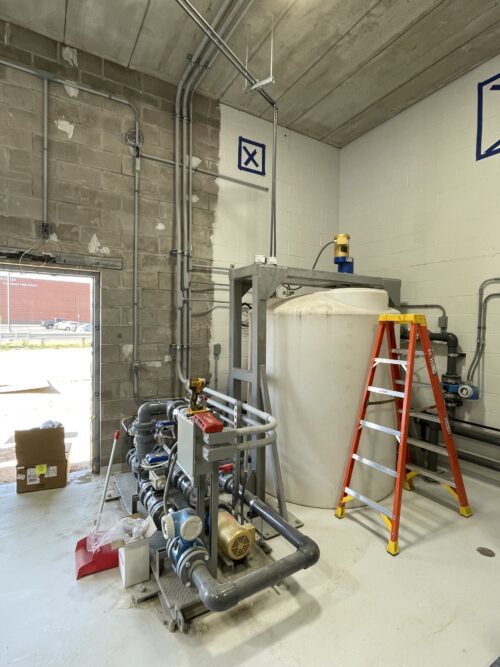
By repurposing space inside the existing production building and avoiding new foundations, the customer dramatically reduced capital costs while still meeting all critical permit requirements.
THE RESULT
Anguil collaborated closely with the customer and their third-party engineer to finalize layouts, instrument placement, and sump integration. Equipment skids were fabricated, leak-tested, and delivered ready for installation. The customer’s maintenance team handled field installation, while Anguil supported commissioning and startup.
Once online, the system performed exactly as intended. Automated controls minimized operator involvement, and remote access allowed Anguil engineers to fine-tune performance during commissioning. Real-time alerts and reporting gave the operations team confidence that compliance was being maintained around the clock.
In the end, the customer achieved exactly what they needed:
- Reliable pH compliance, eliminating the risk of violations and shutdowns
- Controlled discharge rates, fully aligned with municipal constraints
- A significantly lower capital investment than originally anticipated
- Automated, low-touch operation that reduced staffing demands
- A flexible platform that can support future treatment upgrades if regulations or business needs change
By taking a holistic, collaborative approach, Anguil helped the client navigate a complex regulatory challenge without over‑engineering the solution—delivering compliance, confidence, and long-term value.