


THE CHALLENGE

A leading petrochemical company in China constructed a new propylene oxide (PO) production facility. The process generates substantial volumes of waste gas and liquid containing a complex pollutant mix: VOCs including methanol, ethanol, propylene oxide and acetone, along with inorganic compounds such as nitrogen, ethane, propylene, propane, hydrogen peroxide, methyl ether, methane, and hydrogen.
As environmental regulations in China continue to tighten, local authorities required a dedicated treatment system meeting the national standard GB31571-2015 for petrochemical industry and applicable provincial standards before the plant could commence operation.
TAKING ACTION
To address this critical need, the petrochemical company turned to again Anguil. They had prior experience with Anguil equipment having two treatment systems installed for other applications in the region which demonstrated stable long-term performance. Based on this track record, the client commissioned Anguil to design, supply, and commission the treatment system for the new PO plant.
THE SOLUTION
After conducting a comprehensive analysis of the waste stream composition, emission requirements, and operational conditions, Anguil engineers designed a tailored solution for the unique process: an integrated system combining a Thermal Oxidizer (TO), waste heat boiler, Selective Catalytic Reduction (SCR) denitrification unit, economizer, and activated carbon adsorption backup system. This combination was chosen for its ability to address the complex pollutant mix, meet strict emission limits, and deliver economic and environmental benefits.
Waste Gas and Liquid Profile
The streams to be treated originate from multiple process points across the PO plant, including reactors, separation columns, and the intermediate tank farm. Composition, flow rate, and thermal content differ significantly across these sources. Several streams carry high concentrations of combustible organics with wide flammability ranges; others are inert-heavy or dilute. A portion of the pollutant load is in liquid phase, requiring atomized injection rather than standard gaseous feed. This variability demanded a purpose-designed inlet and combustion configuration to ensure complete treatment across all operating scenarios.
Process Flow: From Contamination to Compliant Emission Exhaust

- High-Temperature Oxidation: Combustible pollutants in the waste gas and liquid are injected into the TO via specialized nozzles, atomized with steam for optimal dispersion. Operating at a high temperature of 1,100 ℃, the TO oxidizes the contaminants in an oxygen-rich environment, converting them into water and carbon dioxide.
- Waste Heat Recovery: The high-temperature purified flue gas (carrying substantial thermal energy) is directed to a waste heat boiler that recovers the thermal to produce 30 t/h of superheated steam at 2.4 MPa. The client can reuse the steam in the PO plant’s production processes.
- Denitrification (SCR): High-temperature combustion in the TO produces thermal NOx as a byproduct. To bring NOx within regulatory limits, flue gas is cooled to approximately 320 ℃ and is routed to an SCR unit, where NOx is reduced to nitrogen and water through catalytic reactions, ensuring compliance with NOx emission standards.
- Secondary Heat Recovery: To maximize energy efficiency, an economizer (equipped with a deaerator) is installed at the SCR outlet. This device preheats boiler feedwater by using the remaining thermal from the flue gas, lowering the final exhaust temperature to 160 ℃, improving overall thermal efficiency and reducing stack heat losses.
- Final Emission: The treated flue gas is drawn through a negative-pressure fan and discharged into the atmosphere via a stack, fully meeting the required environmental standards.
Key Advantages of the Integrated System
The solution was designed to address not just compliance, but also the client’s operational and economic needs—offering five core advantages:
High Destruction Efficiency with Energy Saving
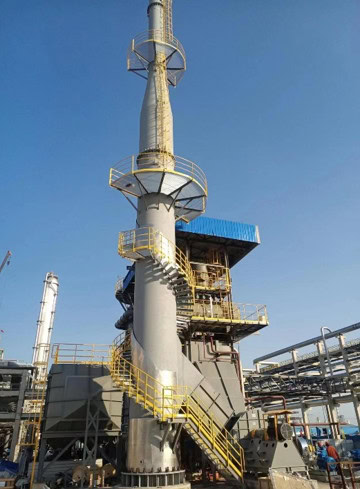 The TO is the heart of the system, delivering a pollutant destruction efficiency above 99.9% while optimizing energy use:
- Complete Oxidation: The TO’s design—including strategically selected and positioned burners, plus internal baffles—ensures thorough mixing of waste gas/liquid and combustion air. The baffles extend the flue gas residence time and promote turbulence, guaranteeing the complex pollutants are fully oxidized.
- Energy Recovery: The waste heat boiler transforms waste thermal energy into usable steam, creating significant economic value. The steam output is matched to the PO plant’s process requirements and fed directly into the plant’s utility distribution system, displacing equivalent natural gas-fired steam generation. At current energy prices, this represents over RMB 50 million in annual economic benefits for the client—turning a compliance cost into a revenue-generating asset.
Smart Burners: To adapt to the plant’s varying operational conditions, combined burners were utilized. This design reduces the total number of burners required and allows real-time adjustment of fuel output to match varying waste gas volumes, minimizing supplemental fuel consumption while maintaining stable combustion temperature.
Superior Safety Assurance
Safety is paramount in petrochemical operations, and the system was engineered to meet the highest global standards:
- Compliance with International Standards: The TO is designed in accordance with the U.S. NFPA 86 standard, a globally recognized benchmark for thermal oxidizer safety.
- Hazard Analysis & Simulation: A Hazard and Operability (HAZOP) analysis is conducted to identify and mitigate potential risks. Advanced simulation tools were also used during the design phase to optimize system parameters, ensuring safe operation under all expected conditions.
Explosion‑Proof and Safety Instrumentation Provisions: All field instruments are specified to explosion-proof standards. Flame arrestors, combustible gas detectors, and emergency shutoff valves are installed at critical inlet and outlet points.
Low Failure Rate for Reliable Long-Term Operation
To minimize downtime and maintenance costs, the reliability is prioritized in component selection and system design:
- High-Quality Components: Electrical and instrumentation parts are sourced from internationally recognized, industry-proven brands—ensuring durability and performance.
Optimized Controls: Rational control system design reduce the risk of component failure, ensuring the system operates stably with minimal interruptions.
Simple and Convenient Operation
The entire system is fully integrated with a Distributed Control System (DCS) and Safety Instrumented System (SIS), enabling full automation. No dedicated on-site operators are required for routine operation—only regular inspections are needed. Both systems allow remote monitoring and control, simplifying management and reducing labor costs.
Emergency Backup for Uninterrupted Compliance
An activated carbon adsorption system is dedicated to the intermediate tank farm’s waste gas. Under normal operation, this stream is processed through the TO. When the TO is offline for planned or unplanned maintenance, the tank farm exhaust is automatically diverted to the adsorption unit, where VOCs are captured before discharge via stack. This maintains continuous compliance without requiring additional operator intervention.
THE RESULTS
Since commissioning, the system has operated stably with no significant unplanned downtime. Destruction efficiency is maintained at 99.99%, and emissions of NMHC, acetone, phenols, methanol, and NOx consistently remain below the limits defined in GB31571-2015 and DB32/315-2016. The project met the environmental compliance requirements for the new production unit and has supported uninterrupted operation since startup.
The system’s consistent performance reinforced the client’s confidence, and they subsequently selected Anguil to design and supply waste gas treatment equipment for another new production facility. That project equally met all design requirements and performance targets upon commissioning. The repeat engagement reflects the client’s sustained satisfaction with Anguil’s technical capability and long-term service support.