
THE CHALLENGE
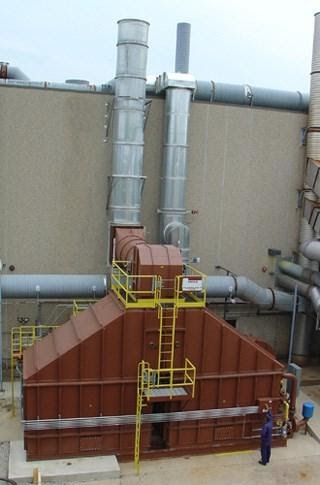
Emission control, and the operating costs associated with meeting environmental regulations, were nothing new for the Coated Products Division of Brady Corp. For nearly 60 years Brady Corp has been manufacturing coated films, demonstrating over that time a commitment to pollution prevention and emission reduction programs. These considerations were magnified when the Milwaukee coating facility chose to implement a new energy-efficient emission control system.
The division maintains 200 different coating formulas on three main continuously operating process lines. Two of the company’s three coaters are operated as so-called “white rooms” to allow the manufacturing of exceptionally clean products. Applying adhesives, topcoats, cast films and other coatings onto a range of substrates requires solvent-based coatings with mixtures of chemicals. Some of the many solvents used in the process are: toluene, MEK, MIBK, heptane, hexane, ethyl acetate, IPA, nitroethane, nMP, cyclohexanone, and 1,3-dioxolane. The dynamic process stream poses many challenges to the company, particularly since it eliminates the option of solvent recovery.
THE SOLUTION
If careful consideration is not given to proper equipment selection, the initial cost of emission control equipment can be negligible compared to the operating costs. With natural gas prices continuing to rise, Brady focused on getting the most efficiency from its incineration equipment.
Since the early 1990s, the facility has spent millions of dollars on air pollution control equipment to meet a variety of Environmental Protection Agency (EPA) regulations imposed on coating companies. The purchases have included thermal recuperative and regenerative thermal oxidizers (RTOs), as well as concentrator systems. For the Milwaukee location alone, Brady has purchased a total of 12 units with a 13th on order. The oxidizers have been used to treat everything from coating emissions to low-point floor sweeps located throughout the facility. As natural gas prices have risen, and with associated costs for emission control equipment steadily increasing, Brady sought ways to reduce their yearly operating and maintenance costs, which were overwhelming.
When one of the old electric RTOs failed, the downtime averaged over a week to replace the cold face support grid and electric heating elements before bringing the unit back up to temperature. The failures happened so frequently, the maintenance department constructed a special tent so the repairs could be done in the rain or snow. The thermal recuperative oxidizers on site had many problems with internal heat exchanger failure; a roller system was installed just to move the large duct transition, allowing access to weld the tube sheet without bringing in a crane.
To reduce maintenance costs, a decision was made to begin replacing the oldest and least efficient oxidizers. The type of systems would be determined by the maintenance team. The first phase of what plant personnel started referring to as its “efficient emission control plan” would replace one of the thermal recuperative oxidizers with a 35,000 SCFM (56,175 Nm3/hr) RTO from Anguil Environmental Systems.
The new system tested out at a destruction efficiency rate of 99.2 percent and was equipped with a hot-gas bypass that allowed it to process volatile organic compounds (VOCs) at rates up to 850 lbs/hour. This high-capacity VOC processing allowed some of the other less-efficient oxidizers to shift their load over to the new RTO through a unique common manifold collection system. With the increased concentration of hydrocarbons in the process air stream, the heat energy content of the VOCs was self-sustained, and the oxidation process required no additional fuel for destruction.
RTO technology utilizes ceramic media in two or more beds as a high-efficiency heat exchanger. Process gas with VOC contaminants enters the RTO through an inlet manifold. A flow diverter valve diverts the gas into an energy recovery chamber, which preheats the process stream. The process gas and contaminants are progressively heated by the ceramic bed as they move toward the combustion chamber.
The VOCs are then oxidized, releasing energy that is transferred to the second ceramic bed, thereby reducing any auxiliary fuel requirement. Heat is transferred from the gas to the ceramic bed so that the outlet gas temperature is only slightly higher than the inlet temperature. A flow diverter valve switches, alternating the ceramic beds so each is in inlet and outlet mode over time. If the process gas contains sufficient VOCs, the energy released from their combustion promotes self-sustained operations. For example, at 95% thermal energy recovery (TER), the outlet temperature may be only 77°F higher than the inlet process gas temperature.
The Brady maintenance team investigated several types of RTO systems, including a new rotary valve system. The rotary valves seemed to be a viable option at first inquiry, but they were a close-tolerance proprietary item that could only come from a specific vendor. A major maintenance concern was the location of the rotary valve. It was discovered to be situated underneath the RTO, presenting logistical issues. Ultimately, Brady chose Anguil’s poppet valve design, believing the maintenance access was more satisfactory. Brady was surprised, and pleased that Anguil was willing to share its complete computer operating program, something other vendors were not willing to do.
Other items on the system included:
- A stairway for access to platforms rather than the usual vertical ladders – a feature especially appreciated in Wisconsin winters
- Replaceable valve seats on the poppet valves and large access doors
- Heavier gauge access doors with fewer bolts to be removed
- Block-off plates after the system fan as required for confined space entry
The second stage of the plan would prove to be a little more challenging, but even more helpful in reducing the company’s operating costs. The EPA’s requirement of a permanent total enclosure (PTE) requires coaters to create negative pressure in all areas of the facility that process any volume of solvents. Due to the layout of the coaters, this became a large volume of exhaust air with very low VOC levels.
Two of the old electric RTOs were treating this high-volume, low-concentration stream from pump rooms, wash-up areas, compounding areas, and floor sweeps located throughout the facility. Large volumes of natural gas were consumed to burn a very small amount of pollutants. In addition, the unit could not be turned off during plant shutdowns because of time-consuming reheat procedure, which could take up to four days.
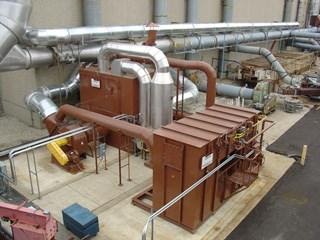
After evaluating the solvent vapors and various concentrations, an Anguil Model 350 (35,000 SCFM or 56,175 Nm3/hr) rotor concentrator and Model 50 (5,000 SCFM or 8,025 Nm3/hr) RTO were selected to handle this portion of the process. By absorbing and concentrating the VOCs they were able to achieve a 10-to-one concentration ratio, requiring an oxidizer only a tenth the size to handle the concentrated process stream. The energy contained in the concentrated stream entering the RTO proved sufficient to allow self-sustaining operation, requiring little to no auxiliary fuel.
THE RESULT
The third, but not final, stage of Brady’s plan is still in motion. They have placed an order for another 35,000 SCFM (56,175 Nm3/hr) RTO to replace the last thermal recuperative system on site. When this system has been installed, heat from the RTO will be used to preheat the facility’s ovens, further reducing energy consumption. The system will have enough capacity to eliminate the final thermal recuperative unit and another aging electric RTO.
In addition to replacing old oxidation technologies at the facility, careful consideration has been given to all the oxidizers as a single system. The company has implemented a dual collection and distribution manifold that allows operators to divert process streams from one oxidizer to another for maintenance or equipment shutdowns.
The impact of these efforts has exceeded expectations for reliability and efficiency. Gas usage on the company’s three coating lines have continued to drop at a steady rate. At a time when gas prices continue to trend high, coupled with increases in production, the reduction in energy consumption drops straight to the bottom line.
Brady Corp is continuing to explore energy reduction strategies and is currently investigating the option of placing secondary heat exchangers on all of its oxidizers. The process would return waste heat to preheat the air streams on all of its other coating lines.