
THE CHALLENGE
Endurance testing of outboard motors for boats typically typically involved continuous operation on closed courses, sometimes private lakes purchased by the engine manufacturers. Some of the tests could reach up to 50,000 miles to simulate years of heavy use to ensure reliability. It was time consuming, required shifts of drivers changing “on the fly,” and was performed in non-controllable environments, which could make the tests difficult to track or replicate.
When a company in Oklahoma decided to build their own enclosed endurance test modules, the Environmental Protection Agency (EPA) required them to control the emissions from the test engines. The company proposed four testing modules, all of which would require air pollution abatement. The initial design exhaust volume was more than 4,400 SCFM (6,940 Nm3/Hr) per test cell. This high exhaust volume per cell posed a significant capital investment and operating cost for the company.
THE SOLUTION
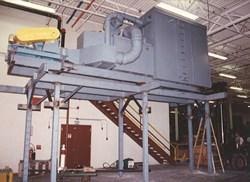
The company believed a thermal incinerator would be the preferred solution due to the low cost of natural gas in Oklahoma. However, after looking at initial equipment and operating costs, they recognized the benefit of using a catalytic oxidizer. After considering different providers, the customer chose Anguil Environmental Systems to solve their volatile organic compound (VOC) problem and ensure the new test cells were within EPA compliance.
Automotive catalysts have proven effective in handling exhaust gases from internal combustion engines, where both un-burned hydrocarbons and carbon monoxide (CO) are destroyed. After a thorough evaluation, it was concluded that the enclosed engine test modules needed significantly less exhaust volume than the 4,400 SCFM (6,940 Nm3/Hr) proposed. Anguil determined that the exhaust from even the largest stern drive engine was under 800 SCFM (1,262 Nm3/Hr) of air. It was critical for the exhaust to be under negative pressure, so no CO would leak into the test facility. Using 850 SCFM (1,341 Nm3/Hr) as a design criterion, Anguil determined that a 6,800 SCFM (10,725 Nm3/Hr) catalytic oxidizer could handle the initial four test modules. The unit was sized to have the capacity for four additional test modules in the future.
THE RESULT
Anguil installed the catalytic oxidizer inside the building on a mezzanine adjacent to the test area. Enough catalyst was provided to handle the initial loading from four test modules, which reduced the initial capital cost. Anguil engineers performed an exhaust stack test analysis to determine what concentration of CO and hydrocarbons were present. The presence of CO dictated a total enclosure around the catalytic oxidizer. Anguil placed an exhaust fan in the enclosure, creating negative pressure and eliminating the possibility of CO leaking into the facility.
The oxidizer was equipped with a variable speed and frequency drive to provide a high degree of turndown if only one test cell was being run. A stainless-steel plate and frame type heat exchanger was used to accommodate high heat release (exotherm) across the catalyst. With the temperature increase, hot spots could form and required management to prevent catalyst degradation and provide temperature control.
Some of the engines tested in the facility were diesel and test runs were lengthy. Since these engines could potentially drift out of specification, a ceramic particulate filter was installed within the catalytic oxidizer down-stream of the gas burner to protect the catalyst from unburned carbonaceous materials. The periodic cycling and high fire of the gas burner eventually vaporized these carbonaceous materials and allowed them to be oxidized by the catalyst.
After approximately eight months of successful operation, the company decided to expand by adding four additional test cells. The new exhaust fans and ductwork were completed by Anguil’s installation crew and additional catalyst was added to meet the company’s increased capacity. Through innovation, the result is a state-of-the-art engine test facility operating safely, and in compliance with EPA requirements.