


THE CHALLENGE
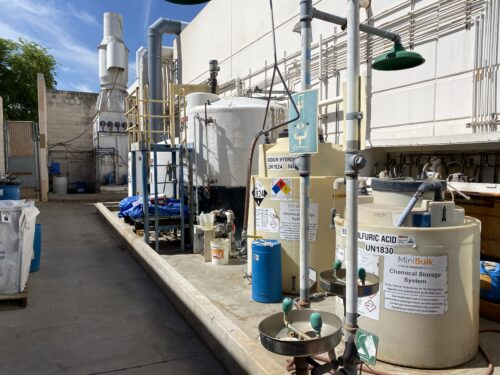 For a semiconductor equipment cleaning company, success had started to create an unexpected problem.
Demand for their cleaning and refurbishment services was growing—but their wastewater treatment system couldn’t keep up. What had once been sufficient had become a daily bottleneck: an undersized, fully manual process struggling to handle increasing volumes of highly variable, chemically complex wastewater.
Each cleaning cycle generated bursts of aggressive waste streams—strong acids like nitric, sulfuric, and hydrofluoric, alongside caustics such as sodium and potassium hydroxide. These streams carried valuable, but challenging-to-remove metals like copper, silver, and gold. Treating them required careful chemical dosing, pH adjustment, and solids separation.
But everything was manual.
Operators physically handled chemicals, measured and dosed them by hand, and managed each batch step-by-step. The process was slow, labor-intensive, and raised clear environmental, health, and safety concerns. Treatment cycles stretched longer than they should, limiting throughput and putting pressure on operations.
Then came another challenge: an upcoming discharge permit change that would require fluoride removal—adding yet another layer of complexity to an already strained system.
The company explored outsourcing the problem through offsite disposal. But the costs quickly made it clear—this wasn’t a sustainable path forward.
If they wanted to grow, they needed to rethink everything.
THE SOLUTION
 Rather than jumping straight to equipment, Anguil partnered with the client to step back and fully understand the operation: how often waste was generated, in what volumes, and how it varied from batch to batch.
That insight shaped everything.
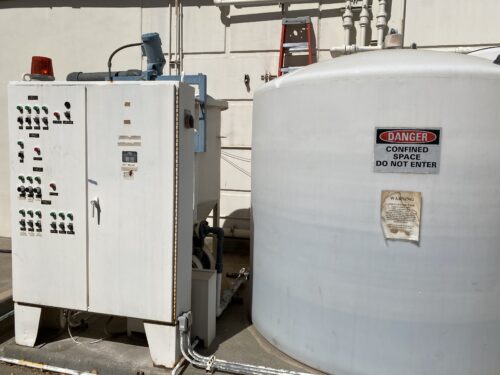
With limited outdoor space available, simply “scaling up” wasn’t an option. The solution had to be smarter, not just bigger. Anguil’s engineers worked alongside the facility team to reimagine how the system could fit—designing tall, high–aspect ratio tanks that made use of vertical space instead of expanding the footprint.
At the same time, treatment chemistry was evolving. Working closely with the client’s chemical engineers, Anguil helped validate an updated process that incorporated fluoride removal through lime softening—ensuring compliance with future discharge requirements without compromising efficiency.
Different approaches to solids handling were also evaluated. While advanced technologies like rotary vacuum drum filtration were considered, the team ultimately selected an upgraded filter press—balancing performance with budget realities.
Every decision was made collaboratively, grounded in both technical performance and practical constraints.
The final system transformed what had been a manual, reactive process into a streamlined, automated operation.
Separate equalization tanks now isolate acidic and caustic waste streams, preventing unwanted reactions and stabilizing incoming flows. From there, wastewater is automatically transferred into a central reaction tank, where treatment programs are executed at the push of a button.
Chemical addition, pH adjustment, metals precipitation, and fluoride removal all occur in a controlled, repeatable sequence—eliminating the variability and labor demands of manual operation.
Even the physical layout was designed with efficiency in mind. A custom elevated platform allows the filter press to discharge dewatered solids directly into a dumpster below, simplifying handling and reducing operator involvement.
Behind the scenes, a PLC-based control system ties everything together, while a user-friendly interface gives operators clear visibility and control without requiring constant intervention.
To accelerate installation, much of the system was pre-assembled on skids—minimizing field work and enabling a faster, smoother startup.
THE RESULT
The impact was immediate—and measurable.
What had once been a constraint on the business became a catalyst for growth.
- Treatment capacity doubled
- Weekly batch throughput tripled—from 3 to at least 9 batches
- Manual labor requirements dropped by over 80%
- Operators were removed from routine chemical handling, improving safety
With the new system in place, the company could confidently meet demand, operate more efficiently, and plan for future growth—all while staying ahead of regulatory requirements.
At its core, this project wasn’t just about wastewater treatment. It was about aligning a technical solution with real business goals.
By taking a collaborative, step-by-step approach—grounded in data, validated through testing, and refined through open dialogue—Anguil helped turn a complex operational challenge into a long-term advantage.
Because the best wastewater solutions don’t just treat water.
They unlock capacity, reduce risk, and move businesses forward.