
 THE CHALLENGE
A company involved in the automotive aftermarket had a paint batch mixing and filling operation that used primers and fillers. They needed to install equipment to handle the volatile organic compounds (VOCs) emitted during their processes. An independent consultant determined the total exhaust volume from the facility was 28,000 SCFM (44,940 Nm³/hr) of air and contained relatively low concentrations of solvent vapors. This combination of high exhaust volume and low vapor concentration posed an operating cost problem. Powder added into the batch mixers generated dust, posing potential hazards to the operators and OSHA (Occupational Safety and Health Administration) violations added an additional challenge.
THE SOLUTION
Anguil analyzed the data, operation, and needs of the customer. A major consideration was on the composition of the solvents and high air volume. Of the solvents used, a small portion was methylene chloride. Chlorinated compounds are a potential poison to most catalytic systems and the company’s consultant recommended a thermal incinerator. Anguil recognized that a less expensive alternative to a thermal unit would be a Chlorinated Catalytic Oxidizer, which is specially designed to process chlorinated compounds. However, Anguil recommended an evaluation of alternate compounds to replace the chlorinated organics. Upon investigation, the company chemist determined all the chlorinated compounds could be replaced with regular organic solvents. Thus, eliminating the need for a Chlorinated Catalytic Oxidizer.
The high air volume was further analyzed. One of Anguil’s strengths is knowledge in capture hooding and air flow reduction techniques. The 28,000 SCFM (44,159 Nm³/hr) exhaust was originally recommended on the assumption that all 13 batch mixing devices could be at their peak mixing and vapor loading capacity simultaneously. Interviewing the facility manager, it was determined that all 13 mixers were never loaded simultaneously.
After a comparison of various proposals, Anguil Environmental Systems was contracted. Anguil developed and designed an air reduction system after mapping the VOCs with a portable Flame Ionizing Detector (FID). This research allowed engineers to determine the area of high VOC concentration and design an innovative capture system that drastically reduced the amount of air treated.
THE RESULT
The company was using floor sweeps as part of their capture system, but they were up to ten feet away from the mixing devices. Additionally, the mixing container covers were poor fitting and extremely heavy. Anguil’s solution included replacing the floor sweeps and tank covers with a close capture hooding system. A series of aluminum custom fabricated covers with integrated flexible duct connectors to draw the vapors and dust directly from the mixers were created. The added benefit of the close capture hooding was a decrease in air volume necessary to capture the vapors from the VOC source.
Anguil determined the VOCs from the mixing room could be adequately captured with 9,000 SCFM (14,194 Nm³/hr) of air and that plans for expansion would not take the exhaust air volume above 12,000 SCFM (18,925 Nm³/hr). Rather than focusing on costly outside air to replace the 9,000 SCFM (14,194 Nm³/hr), Anguil supplied close capture pick-up hoods in the mixing room adjacent to the room containing the fill devices. This air was then transferred into the adjacent mixing room, creating makeup air. The VOC concentration of this air was well below the Threshold Limit Values (TLVs), but the state regulatory authorities determined these VOCs were at an unacceptable limit and should be destroyed. The air supply was introduced on the far side of the mixing room which helped sweep the vapors across the 120 by 60-foot room toward the pick-up points.
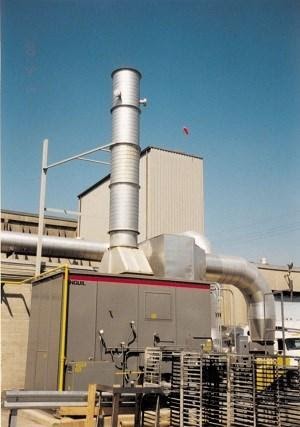
Outside of the building, a 12,000 SCFM (19,260 Nm³/hr) catalytic oxidizer was installed on a concrete pad. Prior to entering the catalytic oxidizer, the airstream was fed through a two-chamber dust collector to prevent the particulates from masking the catalyst or blocking the oxidizer’s plate type heat exchanger. A precious metal platinum catalyst was chosen to destroy the hexane and toluene organics. Catalyst was provided to process 9,000 SCFM (14,194 Nm³/hr) and as the facility capacity increased, more catalyst could be added. Due to the well-designed air reduction strategy, Anguil saved the customer tens of thousands of dollars on their pollution control system while achieving compliance.