
THE CHALLENGE
In the face of rapid industry advancement, semiconductor chip manufacturers are continually looking for an edge in the competition. In the past that required the manufacturers to stay current with the latest trend in wafer sizes. A new option is through innovative pollution control technologies and changing techniques in their production plants.
At Anguil, our customers know they can trust our team to develop and deliver quality solutions to their unique environmental and process challenges. We are experts in environmental efficiency through custom design and manufacturing of air pollution, water treatment, and energy recovery systems.
In one case, a large semiconductor chip fabricator wanted to reduce their environmental impact, maintain their productivity, save on operational costs, and conserve valuable floor space.
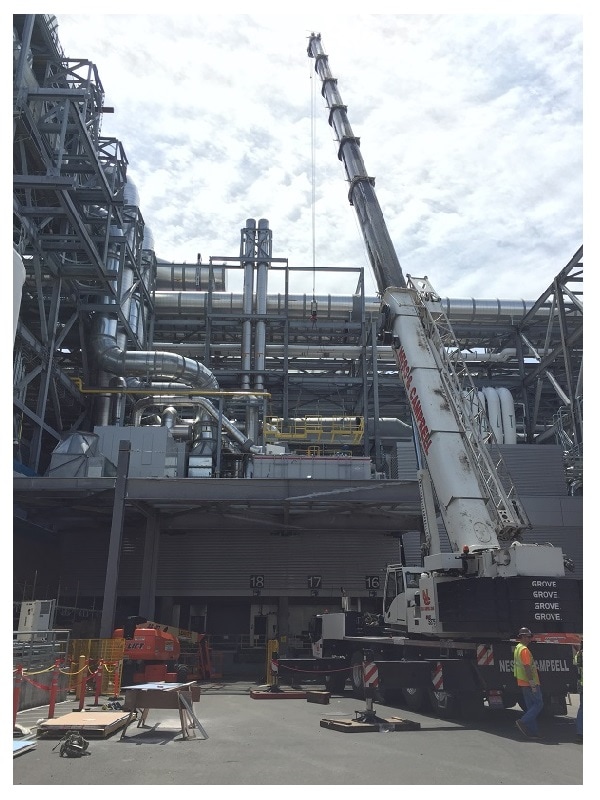 The process of fabricating semiconductor chips generates significant amounts of wastewater and waste gases, both of which require treatment prior to their release into the sewer system or atmosphere. As fabrication operations have increased, so too has the amount of waste produced and, consequently, the need for abatement technology.
The customer approached our team with a request for a new system for their plants. They wanted to stay ahead of their competition by tackling the challenge of reducing their environmental impact without sacrificing their facilities’ productivity and output. While they were currently employing the use of two systems, each with capacities for less than 50,000 SCFM (80,250 Nm3/hr), they were looking for a more effective solution. Ultimately, they were seeking a system that doubled their SCFM volume processing capacity with a 98% VOC removal level.
Their exact system requirements were as follows:
- >100,000 SCFM (160,500 Nm3/hr) volume processing capacity in a single system with the same footprint as the two existing pollution control devices
- >98% VOC removal efficiency
- No upstream pressure fluctuations
THE SOLUTION
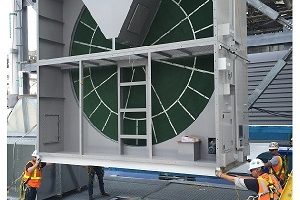
After reviewing the customer’s requirements and discussing the project objectives, our team decided that rotor concentrator thermal oxidizers (RCTO) would be the ideal air pollution control solution. The units were designed with a zeolite rotor concentrator wheel sized to handle more than 100,000 SCFM (160,500 Nm3/hr) of process air, a custom-designed thermal recuperative oxidizer (TO) with a DRE of >99.5%, and a specialized heat exchanger to minimize silica build-up and facilitate maintenance operations.
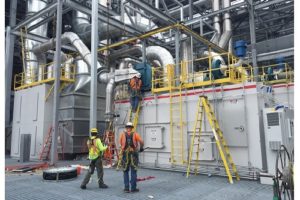
Once fully assembled, all three systems were installed on mezzanine levels of the existing plants. After installation, our technicians completed final commissioning and provided comprehensive operator training. Ultimately, the customer was left with a system that met their needs and a team trained to properly use that equipment.
THE RESULT
Each system was able to exceed the processing capacity and destruction efficiency requested. The new processing capacity is double that of the two previous systems combined.
Additionally, by replacing their old air pollution systems with our more efficient system, the customer was able to save on floor space and operational costs. At the end of the project, the customer was fully satisfied with the performance of all three systems.
Learn more about Anguil’s pollution control solutions in this industry.