


THE CHALLENGE
 A carbon fiber recycling company in China plans to launch a new project aimed at recycling waste high-performance carbon fiber and producing carbon fiber composite products. The recycled carbon fiber is utilized to produce the automotive components.
All processes, from storage and crushing of waste carbon fibers to microwave pyrolysis product collection, must strictly adhere to the VOC emission control standards. The waste tar and other by-products generated are classified as hazardous wastes, and their storage, transportation and disposal must comply with relevant national hazardous waste regulations.
After a detailed assessment of various suppliers, the factory chose Anguil Environmental Asia (Shanghai) Ltd. to solve the problem of waste gas emissions. Anguil Asia has developed and refined their waste gas abatement technology over decades, specially applying in carbon fiber industry. They have successfully installed numbers of effective equipment in this field, earning a reputation for their reliable quality and service.
THE SOLUTION
Before equipment selection, Anguil Asia conducted an energy analysis of the on-site equipment. Based on the required removal efficiency and the exhaust gas parameters, this analysis helped to choose the best treatment technology.
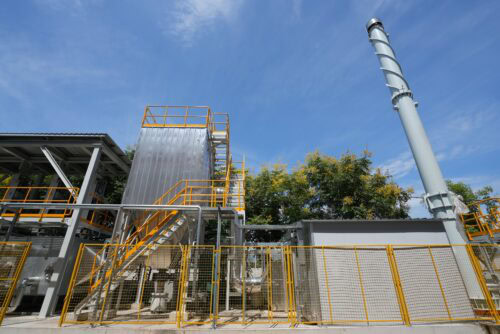
For this project, the main source of waste gas is the pyrolysis stage of the recycled carbon fiber resin. The main VOC pollutants are benzene series compounds, along with carbon fiber particulate dust and tar. Considering the high VOC concentration in the waste gas and the presence of tar derived from microwave pyrolysis processing, Anguil Asia selected a TO (Thermal Oxidizer) equipped with heat exchangers, bag filter and SCR (Selective Catalytic Reduction) system.
The waste gas first enters a thermal oxidizer (TO), where it is decomposed into H₂O and CO₂ at high temperatures and released a large amount of heat. The gas then flows to heat exchangers at the TO outlet, which recover the excess heat for cyclic energy utilization. Next, the gas passes through a dust collector installed downstream of the heat exchangers to remove silicon powder from the carbon fiber precursor. Finally, it goes through a SCR to eliminate nitrogen oxides generated during combustion in the TO, the treated gas is then be clean and discharged in to the atmosphere.
The whole system has the following features to ensure that the system is stable, reliable and efficient:
1. High-Efficiency Thermal Oxidizer (TO) Design for High-Concentration Exhaust Gas: Anguil recommended a TO with an airflow rate of 600m ³ h to effectively treat high-concentration exhaust gas. The cylindrical oxidizer body has an inner cavity insulated with ceramic fiber cotton to maximize the heat efficiency and ensure safe operation. To achieve complete waste gas combustion, the selection and layout of the burners are specially considered; for variable operating conditions, the burner can adjust the fuel output in real-time according to the gas volume for energy savings and emission reduction. The oxidizer’s interior is also specially designed for easy cleaning in case of tar adhesion, ensuring long-term safe operation. Furthermore, Anguil specially designs the pipeline to prevent blockages caused by carbon fiber particles, tar, and other substances in the exhaust gas.
2. Waste Heat Recovery and Temperature Control System: To effectively utilize the waste heat from the oxidizer, a gas-gas heat exchanger is employed to preheat the fresh air, which is then mixed with waste gas in a mixing box and introduced into TO unit. Additionally, a gas-water heat exchanger is installed to cool the gas with cooling water before it is directed to the dust collector and SCR system for further processing.
3. Online Soot Blowing for Heat Exchanger: Benefiting from Anguil Asia’s mature design and extensive experience in carbon fiber industry, the heat exchanger is equipped with soot blowers for online cleaning, and ensuring continuous production.
4. Integrated Dust Removal Unit and Flexible Cleaning Control: The dust removal unit integrates three key processes: baghouse filtration, ash transfer, and packaging. The system features dual-mode “Remote/Manual” cleaning control. In automatic mode, a pulse controller manages timed cleaning cycles. The manual mode is primarily used for system startup, shutdown, and maintenance.
5. IDLE Mode for Flexible Production Scheduling Adaptation: To meet the customer’s flexible production schedule, an IDLE mode was integrated into the PLC program. When the production line is down, this mode maintains the oxidizer at a lower temperature, significantly shorten the reheating time when resume operation.
6. Fully Automatic PLC Control System: The system is equipped with a fully automatic control system centered on a PLC, which significantly reduces labor costs. The system features integrated hardware and software interlocks, ensuring precise and rapid control to effectively guarantee operational safety.
THE RESULT
Utilizing natural gas as an auxiliary fuel, this system achieves excellent performance in treating high-concentration waste gas, with a destruction efficiency of up to 99.99%. After the abatement, the VOC concentration complies with both national and local VOC emission control standards. The system has successfully met all design objectives, demonstrating its outstanding effectiveness in VOC abatement.