


THE CHALLENGE
Food production is a demanding and competitive process. Executives are continually confronted by product development processes, competitors, and deceptive practices for economic profit. In today’s environmentally aware climate, reputation is crucial. Producers worry they could be perceived as environmentally and socially irresponsible. If they are, some retail chains may refuse to stock their brands until they make extensive, and often expensive changes.
Many producers are facing a new, and unexpected, complicating factor: failing and undersized Publicly Operated Treatment Works (POTWs). Wastewater previously discharged with little processing may now be subject to surcharges. Publicly Operated Treatment Works struggle to meet increased Environmental Protection Agency (EPA) regulations, while making infrastructure improvements to accommodate the greater load.
Another obstacle: treatment system operators, with decades of experience, are retiring. Unfortunately, the knowledge of how to run their outdated treatment system retires with them. This leaves system owners and executives wondering how to replace that knowledge base while meeting new regulations.
In the face of increased regulatory control, rising environmental concerns about wastewater, and a retiring workforce, food producers are seeking cost-effective ways to stay in compliance.
THE SOLUTION
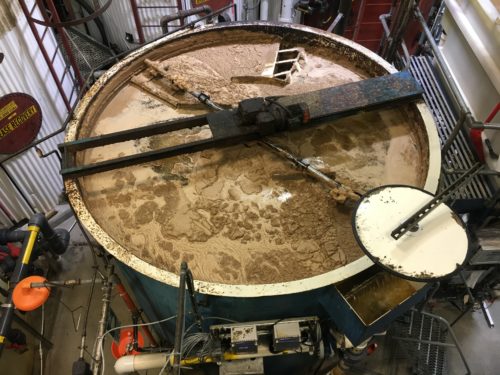 Anguil Environmental provides highly engineered equipment and service solutions that solve complex industrial air and water concerns. Anguil follows a very simple, but effective, four-step approach that addresses economic, operational, and compliance challenges.
The first step is to evaluate the situation and parameters. We collaborate with the client to understand their challenges and determine the project needs and objectives. We gather benchmark data to assist with alignment of solutions that offer the best return on investment (ROI), then work with the customer to understand their decision process and criteria to ensure we can fulfill all their requirements.
The second step is exploring all treatment and operational processes in the Anguil lab. Anguil confirms all potential treatment and process options that align with the customer objectives. This step involves wastewater samples in our in-house wet lab to validate potential treatment protocols.
Testing in-house provides on hand data for evaluation of viable treatment options, which is then used to generate a simple Process Flow Diagram (PFD) to illustrate the equipment needed to meet customer parameters.
The third step is placing a pilot system onsite to test waters. With the client satisfied with our lab trials, we ask if they require a pilot system to validate the treatment approach in normal conditions onsite.
THE RESULT
The fourth, and final step in the process is commercial deployment. After completion of lab testing, discussion of various equipment options and testing against the business case, Anguil provides a firm proposal for a treatment system which would meet the treatment efficacy and business needs of the customer. The proposal contains detailed information on the treatment system, estimated operational costs, and options for installation, start-up, and commissioning. The flexible approach allows the customer to choose the package that best suits their needs. Additionally, Anguil’s Aftermarket and Service group is proactively in touch, ready to provide long-term system, and parts support.
Anguil follows a better approach to solving complex water challenges, which starts with listening to the client’s needs and business case. Anguil advocates an efficient process that would provide the client with the information they want to make an informed decision.