
THE CHALLENGE
Once the world’s busiest airport, Hong Kong’s Kai Tak Airport closed its runways in 1998. When the airport was decommissioned, the government planned to rapidly clean the site for commercial and residential development. After decades of various fuels and chemicals leeching into the soil, the site required an extensive and sophisticated groundwater cleanup. A system that could destroy a minimum of 95% of the volatile organic compounds (VOCs) and minimize operating costs was necessary. Since the project generated intense government interest, and was highly publicized, the chosen treatment system had to be both proven and reliable.
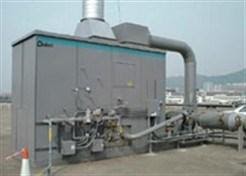
After an extensive evaluation of various VOC treatment solutions, the consultant selected a system from Global Technologies, the remediation division of Anguil Environmental. With their extensive engineering support, industry-leading reliability, and history of solving difficult remediation problems around the world, Global was the clear choice. Global engineers performed a careful evaluation of the data and recommended a Model 80 Remedi-Cat ™ forced draft system. The system processes 8,000 SCFM (12,616 Nm³/hr) of VOC-laden air and provides at least 95% destruction rate efficiency.
Global Technologies’ experience with processing large air flows and irregular organic loading was crucial to this project. The proven performance of Global treatment systems provided the Kai Tak project engineers the confidence to design an innovative remediation plan. Global Technologies’ vapor treatment system was at the heart of this strategy.
THE SOLUTION
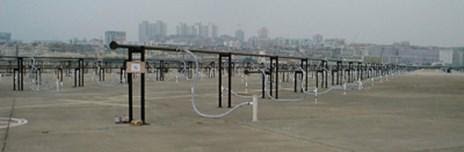
Taking an aggressive approach to remove the subsurface contaminants, the engineers installed 2,000 soil vapor extraction (SVE) wells and 1,000 sparge wells across the old airport tarmac. The vast airflow was directed from the wells to a single treatment system. This strategy provided significant savings in energy, fuel, and personnel compared to a modular approach. A modular solution would require more treatment systems to treat a limited number of wells.
Global chose a catalyst that utilizes honeycomb shape construction to provide superior airflow and low pressure drop. The catalyst selected had undergone extensive technical development, and field-testing, and was chosen to accommodate the unique airflow volume, the amount and type of VOC, and the desired destruction efficiency of the project.
Another key design feature of Global Technologies’ vapor treatment system was the variable frequency drive (VFD). The VFD controls the speed of the system fan, regulating airflow through the system and allowing the oxidizer to efficiently handle the air volume fluctuations from the 2,000-plus extraction wells. With a maximum turndown ratio of 10:1, the VFD produces energy savings far superior to an inlet vane damper. Global provided the VFD with a particulate filter and housed it in a NEMA 4 enclosure to protect it from the sun and outdoor elements.
Like all Global Technologies’ systems, the Model 80 Remedi-Cat™ was manufactured with the highest quality workmanship and construction materials. The heat exchanger and reactor were constructed of 304L stainless steel with continuous leak-tested welding around all seams. To withstand the natural elements, the exterior shell was constructed of aluminized steel with a coat of UV resistant polyurethane paint. High-density mineral wool was placed between the inner and outer shells to maintain external skin temperatures at safe levels.
THE RESULT
A final consideration was worker and equipment safety, which is a significant concern for every Global Technologies system, but is especially important on a high-profile project like Kai Tak. With safety in mind, Global developed a state-of-the-art Programmable Logic Controller (PLC) which allows safe and intelligent operation with minimal risk. The PLC provides immediate troubleshooting, first-out shutdown detection, and operator assistance for start-up. Global Technologies’ user-friendly features provide the on-site operators with more control, decreased downtime, and reduced maintenance costs.
Global Technologies’ understanding of a customer’s unique needs, coupled with the engineering know-how necessary to fulfill these needs, resulted in another satisfied customer. The cost-saving strategy of controlling numerous wells with one treatment system was made possible by Global Technologies’ ability to accommodate the large and varied airflow from the wells. Global Technologies’ aggressive and innovative treatment strategies assisted the once busiest airport move into a cleaner and safer 21st century.