

OXIDIZER SERVICE SERIES: PART 2
Whether it is still on the drawing board or has been on site for years, your air pollution control system represents a significant investment and a long-term commitment to environmental compliance. A well-crafted maintenance plan for your oxidizer will allow you to get the most from your investment over the entire life of the system.
Many will come to this article hoping for a one-size-fits-all checklist for maintaining an oxidizer system. As a company that offers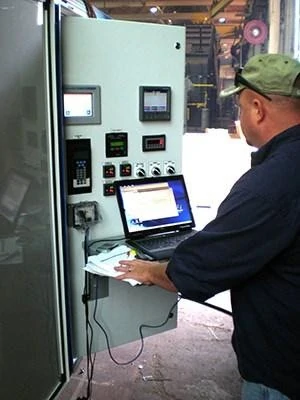 service on any oxidizer regardless of style or original manufacturer, we at Anguil have long wanted the same. A set formula for success would certainly make life easier. Absent of knowing anything else about the operating context of a particular oxidizer system, our best recommendation for a maintenance plan is as follows:
- Gather all the system documentation as listed in Part 1 of our Oxidizer Service Series. Ensure these documents are accessible to system operators and service providers.
- Stock the recommended spare parts for your oxidizer system (more on this in Part 3 of our Oxidizer Service Series)
- Establish a monthly checklist of system inspection points and make sure your operators are comfortable with what to check and how to record their findings
- Maintain an operator logbook or journal of system issues
- Obtain a yearly Preventive Maintenance Evaluation (PME) from an independent or third-party oxidizer service provider such as Anguil
- Establish remote access capability to your system’s controls from an oxidizer service provider such as Anguil
Some may choose to take this basic recommendation for a maintenance plan, stop reading here, and run with it. We would agree that anyone complying with all the steps as outlined above is indeed trying to maintain their oxidizer system. However, having an Oxidizer Service Provider like Anguil visit your site could jump-start the implementation of such a plan.
Maintenance Plan Considerations
The following influences the decision to utilize an oxidizer maintenance plan:
Production Uptime – An informed staff and a transparent maintenance plan will allow for maximum production uptime, prevent costly shutdowns, and enable a prepared response to operational irregularities.
Compliance with Environmental Regulations – The language in many air permits requires operators to stock spare parts, keep historical service documentation, and maintain the system according to the manufacturer’s recommendations. Running out of compliance parameters can not only be costly but could potentially turn into a public relations disaster.
Compliance with Safety Regulations – Compliance codes often require that safety evaluations be performed on an annual basis. Anguil incorporates these safety assessments as a part of our standard 75+ point Preventative Maintenance Evaluation.
Operating Cost Reduction – A good maintenance plan will often pay for itself by ensuring your oxidizer system is running at peak efficiency and with minimal downtime.
Maintenance Plan Elements
The right maintenance plan for one company might not be the right plan for another. Anguil considers the following to be components of a customized comprehensive maintenance plan:
- System Documentation – Gather all the documentation in one binder as outlined in Part 1 of our Oxidizer Service Series. Ensure this documentation is available to both system operators and service providers. We recommend storing relevant documents
 inside the control panel for easy access.
 - Recommended Spare Parts Package – An Oxidizer Service Provider like Anguil can identify the critical components, recommended components, and convenience items you should stock to maintain smooth operation of your system and limit production down time.
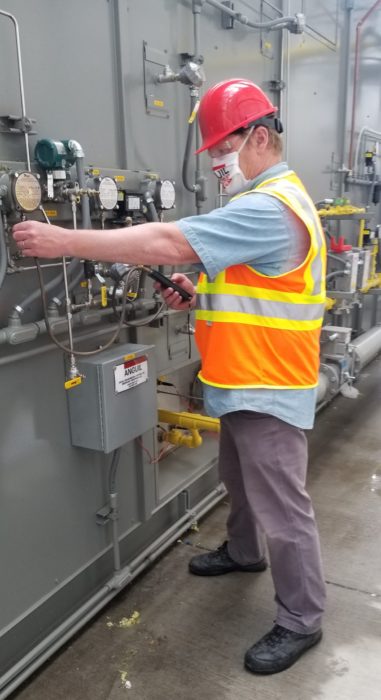
- Annual Preventive Maintenance Evaluation (PME) – Often done by an Oxidizer Service Provider like Anguil. This is not just our advice; this is rapidly becoming part of Permit Codes and Compliance – both environmental codes and safety codes. Anguil’s standard PME program includes a two-to-three-day service visit utilizing a 75+ point checklist to ensure your oxidizer meets air pollution control standards. After, results are sent by formal report for your maintenance records.
 inside the control panel for easy access.
The next four options can be performed in conjunction with a PME visit or separately as stand-alone services.
- Destruction Removal Efficiency (DRE) Evaluations – An oxidizer service provider like Anguil can check the VOC destruction efficiency of your system on site with portable testing equipment or via laboratory analysis of air samples. This service keeps you on track with system performance and verifies compliance. It is ideal as a pre-test to help eliminate “surprises” during expensive formal compliance testing.
- Repeat Operator Training – Maintenance personnel take pride in servicing the equipment when they are familiar with the operation. Years one and two of an oxidizer’s life can present different maintenance challenges than years three and beyond. Repeat training keeps operating personnel prepared to meet evolving service needs. Repeat Operator Training is also becoming a requirement in NFPA codes.
- Catalyst Services – At the heart of every Catalytic Oxidizer System is the catalyst bed. When properly maintained, the catalyst bed can provide years of high VOC destruction at temperatures well under those required for thermal oxidation. Anguil offers a full program of catalyst services including evaluation, testing, rejuvenation, replacement, and the purchase back of “spent” catalyst for recycling.
- Split Preventative Maintenance Evaluations – Some facilities have minimal downtime available for system repairs but still want to be prepared with the right parts and contractors when their downtime occurs. They may elect a Split-PME scenario, which starts with a one-day system evaluation visit by a Field Service Engineer. A second visit is scheduled for the Field Service Engineer to return with parts and materials identified previously, prepared to execute the recommendations immediately.
Other areas to consider in maintaining support of your oxidizer include semi-annual Preventive Maintenance Evaluations (PMEs), remote login capability, operating cost reviews, maintaining an operator log book, weekly/monthly inspections, as well as multi-year and multi-facility maintenance programs.
- Semi-Annual Preventative Maintenance Evaluations – For some, a once-yearly comprehensive Preventive Maintenance Evaluation is not enough. Overall system balancing, operational cost verification, and inventory of spare parts should be conducted semi-annually instead. Depending on the complexity of your system, you may wish to contact Anguil to perform this service for you.
- Remote Login Capability – Establishing remote login access is one of the most important things you can do when creating your maintenance plan. Remote Access Capability has recently become a game changer in the oxidizer service world. For the companies and oxidizer systems we service, when the capability is in place, it is both a lifeline during system upsets as well as a “force-multiplier” when our Field Service Engineers are on site. It is akin to getting the experience and knowledge of several engineers on site, for the price of one. Adding this service quarterly is becoming a popular option. In today’s world, no oxidizer end-user should be left without this critical safety net in place. Don’t wait for an emergency to find out the connection isn’t there. For those with this feature, make sure to regularly test your connection.
- Operating Cost Review – Do you know exactly how much your system should cost to run? Are you getting the most for your operating dollars? Anguil offers an Operating Cost Review Program that can answer these questions and provide cost-saving recommendations tailored for your oxidizer system.
- Operator Logbook – Thorough service history documentation, including a record of daily, weekly, and annual inspections, is often a requirement for an air permit. A comprehensive operator log will help diagnose operating irregularities and could prevent costly malfunctions down the road.
- Weekly Walk-By Inspections – Typically performed by your own workforce. An Oxidizer Service Provider like Anguil can custom design weekly inspection checklists for your specific oxidizer system.
- Deeper Monthly/Maintenance Day Inspection Checklists – For our Monthly Inspections program, we provide a list of the system components needing inspection, independent verification, or calibration. Our goal is to train your maintenance team to feel comfortable performing the monthly checks on their own.
- Custom Maintenance Plans (Multi-Year and Multi-Facility Packages) – Developing a maintenance plan with an Oxidizer Service Provider builds a strong service relationship built on trust and long-term oxidizer expertise. Anguil’s custom maintenance plans include multi-year deals for individual plants or for multiple facilities. Custom multi-year and multi-facility maintenance plans can offer numerous benefits.
Routine Maintenance Benefits
- Smooth Equipment Turnover Between Project Engineering and Production Engineering Teams – Many oxidizer systems are purchased via a project engineering team who then turns the equipment over to production teams. This hand-off can proceed more smoothly if the production team sees there is a service agreement already in place.
- Reliable Budgeting – Having a multi-year service plan takes guesswork out of operational budgeting.
- Consistent Service History – By having a service history log, despite retirements or other turnover in the workforce, the service schedule remains consistent.
- Knowledge Sharing – Maintaining service history at the plant level can be difficult enough. A corporate level maintenance plan can be a conduit for improved knowledge sharing between plants.
- Uphold Corporate Values – Environmental Compliance is often part of a Corporate Level Mission Statement.
Reliability Centered Maintenance
Anguil participated in a three-week-long Reliability Centered Maintenance (RCM) evaluation of an oxidizer system. This system treats the exhaust from a critical production line in one of the most highly regulated areas of the country. RCM is a landmark maintenance concept defined in John Moubray’s book Reliability-Centered Maintenance as “a process used to determine the maintenance requirements of any physical asset in its operating context.”
A team of Anguil personnel, along with the facility’s maintenance team, equipment operators, electrical controls specialists, and EHS staff were guided by an RCM facilitator. The team went line-by-line through the oxidizer electrical schematics, sequence of operation, control programs, and environmental permit requirements to define the system’s functions and possible failures. Using the framework of the RCM program, the team generated lists of potential redesigns, required procedures, a compulsory spare parts program, and implementation reports for the system. This was no small task — the final report was over 400 pages long! The evaluation was a significant investment in money and manpower for both Anguil and the company involved.
The biggest takeaways from this experience were:
- This is the level of training operators of oxidizer systems deserve but rarely receive.
- The importance of “Operating Context” in determining a suitable approach to the long term maintenance of an oxidizer system.
To further illustrate the idea of operating context, consider that oxidizers today are being installed into production scenarios where they:
- May be allowed to be offline for several weeks or months each year.
- May force the end-user to stop all production immediately when offline, in some cases triggering “Notices of Violation” and fines upon any upset condition.
- May be treating exhaust gas streams that are immediately dangerous to life and health.
- May be the sole source of heat for the process to which they are attached.
Each one of these different operating contexts plays a major role in the final determination of a maintenance plan for an oxidizer system.
Not everyone can afford a formal RCM maintenance program for their oxidizer system. There are also industries with enough acquired experience where such an effort may not be required. However, an effective and custom maintenance plan adhering to minimum requirements can be crafted with help from an Oxidizer Service Company like Anguil. A customized program will prolong the life of the equipment while staying within the parameter of an operating budget.
There is no one-size-fits-all solution for crafting a quality oxidizer safety and maintenance program. At Anguil, we strive to offer a wide range of services to make crafting even a basic maintenance plan an essential and affordable investment. Our experienced service personnel look forward to assisting in designing the smartest maintenance program for your company.
This is the second of four parts in Anguil’s Oxidizer Service Series. We encourage you to also view Part 1: Better Maintenance Starts With Better Documentation as well as Part 3: Stocking Spare Parts for Your Oxidizer System and Part 4: Oxidizer System Optimization.